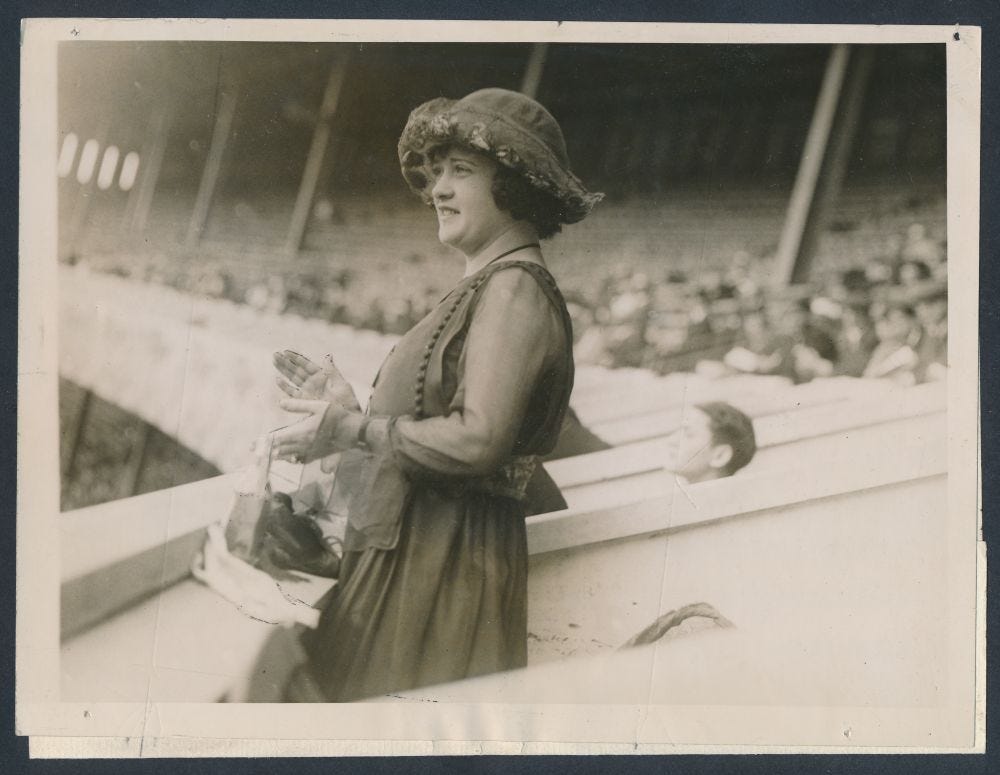
Rarely, very rarely, an athlete comes along that transcends the sports pages and becomes an international icon. They’re so good that they become permanently associated with that sport, like Michael Jordan and basketball or Wayne Gretzky and hockey, so famous that even if you know nothing about the sport itself, you know their names. We call these athletes “superstars,” and there is perhaps no better example of a sports superstar than Babe Ruth.
Everyone knows who Babe Ruth is. We are almost a century on from his accomplishments on the baseball diamond, and we are STILL talking about what he did; that’s staying power that few sports figures can match. He was so good at baseball that the game itself changed to better suit his playstyle, and has never gone back to the way it was before he came along. Everybody loved him, even when he got into trouble, which he did frequently.
The problem with Babe Ruth is that so many myths and legends have sprung up around him that they get confused with facts, to the point that at times it’s difficult to pin down just who he was, or to quantify how important he was to the game of baseball and American history. Sure, everyone knows who Babe Ruth was, but do they actually? The story of Babe Ruth is a baseball story, sure, but it’s also a human story, and those are always the hardest ones to tease out of the pages of history and legend.

From the Reformatory to the Big Leagues
For most of his life, George Herman Ruth Jr thought he’d been born on February 7th, 1894. That was what his parents had told him, after all. It wasn’t until later in his life when he applied for a passport that he discovered his birth certificate said he’d been born on February 6th, 1895. Like many things about the Ruth legend, no one is really sure of the reason for the discrepancy.
He was born in Baltimore, Maryland, in a tough working-class neighborhood on the waterfront. His father ran a saloon and apparently had little time to raise his son, who ran wild in the streets and became a delinquent. At the age of 7, he was sent to St. Mary’s Industrial School for Boys, a combination reform school and orphanage run by the Xaverian Brothers, a Catholic religious order. It was a grim place to grow up, with similar conditions to a prison. Ruth would spend over a decade there.
The Brothers at Saint Mary’s, like many such institutions, encouraged their charges to participate in athletics, believing it would keep them in good health and cut down on the amount of trouble they got into. The most popular sport played at the school was baseball. This is hardly surprising: baseball had become the most popular sport in America over the last twenty years. Everyone played, from school boys all the way up to the Major Leagues, which had contested the first World Series in 1903.
Ruth loved baseball, and it soon became apparent that he was good at it too. At St. Mary’s, he usually played on teams of boys several years older than he was, and by the time he was 16 he was the school’s best player. He became a pitcher, the player responsible for throwing the ball to opposing hitters to try and get them out, and he was so talented at it that Jack Dunn, the owner of the minor league Baltimore Orioles, signed him to a professional contract in January 1914, at the age of either 19 or 20 depending on which date of birth you used.
Finally released from the walls of St. Mary’s, the young Ruth wanted to see everything, do everything, experience everything all at once. He was naive about the world in a way that charmed his teammates, who soon gave him the nickname “Babe,” because he looked and acted like a big kid. The nickname stuck, and for the rest of his life, hardly anyone ever called him “George” again.
Ruth may have been a kid, but he pitched like a seasoned pro. He won 14 games for the Orioles in half a season with the team before Dunn, beset by money troubles, sold Ruth’s contract to the Boston Red Sox (pronounced like “socks”) along with another pitcher named Ernie Shore. Babe Ruth was going to the big leagues.
Pitcher to Hitter, Boston to New York

Ruth didn’t play very much for Boston in 1914. His breakthrough came the next year, when he won 18 games and helped them win the American League championship (known as a “pennant”) before defeating the Philadelphia Phillies (pronounced “fillies”) in the World Series. In 1916, he was even better, with 23 wins and another World Series title, this time over the Brooklyn Dodgers. In 1917, they didn’t win, but that wasn’t his fault: he had 24 wins, bringing his total over three full seasons to 65, an average of over 20 a year. By the end of 1917, he was considered the best left-handed pitcher in baseball, and if he had continued on that way would surely have been remembered as one of the best pitchers in the history of the game.
But Babe Ruth was a curious oddity in baseball: a pitcher who could also hit well. As a rule, pitchers and hitters are like two different species of baseball players in the big leagues. Each discipline is so specialized that if you’re good at one, you’re not good at the other. Pitchers are generally so bad at hitting that in recent decades, they’ve been replaced in the batting lineup with a “designated hitter” so that they can focus on throwing the ball. But those rules didn’t apply to Babe Ruth, oh no. He seemed to be just as good at hitting as he was at pitching. So good, in fact, that his manager decided to try and try him in other positions on days when he wasn’t pitching so that they could keep his bat in the lineup. In 1918, when the Red Sox won a third championship, and in 1919, Ruth split his time between pitching and playing in the outfield, and defied all baseball logic by being good at both.
What made Ruth so unique as a hitter was how hard he could hit the baseball. In those days, baseball was a game dominated by pitching and defense, while offense could be hard to come by. The home run, hitting the ball out of the park for an automatic score, was a rarity, with most hitters only managing a couple of them a season. But Babe Ruth? He hit home runs. And he hit them in bunches. In 1919, he set a new Major League record for home runs hit in a season when he cracked 29 of them, and the crowd loved him for it.
At the end of the season, something happened that changed the course of baseball history. The Boston Red Sox were owned by Harry Frazee, a Broadway showrunner who had spent gobs of money on the team since he bought it in 1916 to make it one of the best in the league. But at the end of the 1919 season, he was in deep financial trouble. Deeply in debt, he risked losing the ballclub and financial ruin unless he could quickly raise cash. The only way to do that was to sell off the best assets he had: the contracts of his star players.
Frazee was in a very public feud with American League President Ban Johnson at this point, so one of the only other owners willing to make a deal with him was Jacob Ruppert, co-owner of the New York Yankees. Ruppert had made his fortune in the brewery business, but with Prohibition bearing down on the country, Ruppert began to rely more and more on his baseball team for revenue, which meant he needed a star attraction to put fans in the stands. The biggest box office draw in baseball at this point was Babe Ruth, so if Frazee was selling, Ruppert was buying. Ruth was sold to the Yankees for $100,000 in cash, plus a $250,000 loan. The news shocked the baseball world: Yankees fans were delighted, while Boston fans were devastated.
The sale of Babe Ruth marked a dramatic reversal of fortune for both clubs. The Red Sox, which had won the World Series 4 times between 1912 and 1918, wouldn’t win another until 2004, 86 years later. In that time, the Yankees, which to that point had yet to appear in the Series, would win 26 championships and become one of the richest and most storied franchises in all of sports. As the decades of futility piled up, Red Sox fans began to believe their team had been cursed, that they were all being punished for the mortal sin of sending Babe Ruth to the hated Yankees.
Baseball Renaissance

There is a legitimate argument to be made that Babe Ruth saved baseball in the early 1920s. In 1920, during Ruth’s first season with the Yankees, eight members of the Chicago White Sox were banned from baseball for life after they were accused of taking money from gamblers to lose the 1919 World Series on purpose. The “Black Sox” scandal, as it became known, threatened the future of baseball, as nobody would pay to watch games if they believed that the results were fixed. Babe Ruth and his prodigious hitting brought people back to the stadiums, and kept interest in the game going as baseball weathered the storm.
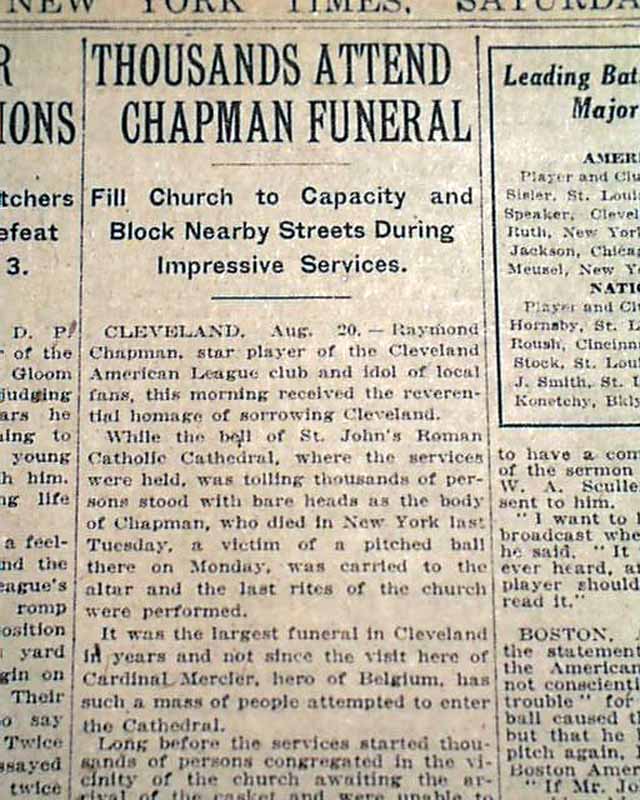
Something else happened in 1920 that Babe Ruth would indirectly benefit from, an on-field tragedy that would change the way the game was played. On August 16th, 1920, Ruth watched from left field as his teammate Carl Mays pitched to Cleveland Indians hitter Ray Chapman. A ball got away from Mays and struck Chapman in the head, fracturing his skull and driving chips of bone into his brain. He took a few steps towards first base and then collapsed. Early the next morning, he died, the first and only on field death of a player in Major League history.
Witnesses said Chapman never even attempted to move out of the way of the fatal pitch, probably because he couldn’t see the ball. In those days, players typically used the same baseball for the entire game, so in the later innings, it was dirty and hard for the batter to see. Pitchers also routinely applied foreign substances to the ball, like spit or tobacco juice, or scuffed the ball with their fingernails or an emery board, so it moved erratically, making it harder for the batter to follow. After Chapman was killed, baseball executives decided something had to be done and changed the rules, which persist to this day: baseballs are removed at the first sign of wear, and players are forbidden from altering the ball or putting anything on it.
The rule change had an immediate effect on the game: offensive production exploded. Batting averages went up, more runs were being scored, and more home runs were being hit. No one epitomized this change more than Babe Ruth. When he came to the Yankees, he transitioned full-time into an outfielder: he would only pitch in five more games the remainder of his career. 1920 marked the start of the Babe Ruth era, as he began to dominate baseball in a way few athletes have ever dominated their sports. He absolutely destroyed his own record, hitting 54 home runs; the next closest player had only 19. In 1921, he was even better. He set a new record, 59, and after only three full offensive seasons, he already had the most career home runs in Major League history. That year, he led the Yankees to their first pennant, losing to the New York Giants in the World Series.
Problem Child, Golden Child

People packed the stands to watch Ruth hit wherever he went, smashing attendance records over and over again. After the 1921 season, Ruth signed a new contract that paid him $52,000 a year, an unheard-of sum for a baseball player. It was more than some teams paid their entire roster. Despite this, he made even more money from endorsement deals and exhibition and vaudeville appearances than he did from his player contract, the first athlete in history known to have done so. Crowds followed him wherever he went, clamoring for an autograph or to shake his hand. Ruth reveled in the attention, whether it be from a school boy or a newspaper reporter. Ruth was great copy for the papers, answering every question, even silly ones, and always willing to have his picture taken. They competed with each other to bestow the most outlandish nicknames on him: he was the Bambino, the Sultan of Swat, the Colossus of Clout, the Maharajah of Mash, and a dozen others.
By this point, Ruth was becoming as well known for his off-the-field exploits as his on-field production. His appetite for food was legendary: he loved to eat, and in massive portions, his weight would see-saw up and down a lot over the years. Alcohol was banned in the United States by this point, but those with money had no problem getting it if they wanted it, and Ruth put the good stuff away by the barrel. As for women….well, let’s just say his stamina in that department, as well as the sheer number of women he disappeared into his hotel rooms with over the years, was legendary among his teammates, even if it tended to be overlooked by the newspapers.
In 1922, Ruth was suspended five times throughout the season for various offenses after drawing the ire of everyone from his manager, Miller Huggins, to the newly anointed Commissioner of Baseball, Judge Kenesaw Mountain Landis (that’s not a nickname; in case you were wondering, he was actually named that by his father). He had thrown dirt in the face of an umpire, leaped into the stands to try to beat up a heckler, almost gotten himself killed in a car accident, and threatened to beat up another umpire. Losing for the second year in a row to the Giants in the World Series was just the icing on the cake of a disappointing season. Ruth was lambasted by everyone, accused of setting a bad example to the children that looked up to him, and he promised reform.
1923 was the start of a new era in New York. The Yankees had been playing their home games in the Giants’ home park, the Polo Grounds. Once the Babe arrived, the Yankees started drawing more fans to the park than the Giants did, which was embarrassing to the Giants’ management. They told the Yankees their lease wouldn’t be renewed and they would have to play elsewhere. Ruppert bought land in the Bronx and started construction on a new ballpark, Yankee Stadium, that opened during the 1923 season. The dimensions of the new ballpark were specially designed with Babe Ruth’s swing in mind, and it was only fitting that he christened it with a home run during the first game played there. Yankee Stadium would become known as “The House that Ruth Built” and would serve as the Yankees’ home stadium until the end of the 2008 season, when it was demolished to make way for its replacement.
The Yankees stormed to the pennant in 1923, again facing the Giants, and the third time proved to be the charm, as they finally defeated their crosstown rivals to win their first championship, Ruth’s fourth as a player. His popularity was as strong as ever, but his poor impulse control would rear its head again soon enough.
The Bellyache Heard Round the World

1925 was the low point for the Babe both personally and professionally. During spring training, he became dangerously sick and had to have surgery to repair what his doctors called an intestinal abscess. The exact nature of his illness remains a mystery, but it seems likely it had something to do with his hard partying lifestyle. Sportswriters jokingly claimed that Ruth had overindulged on hot dogs and soda pop, and nicknamed the illness “the Bellyache Heard Round the World.”
Around the same time, Ruth’s marriage to his first wife, Helen, effectively came to an end. The two had married in 1914, during Babe’s first season with the Red Sox, and like many teenage romances, it was destined for heartbreak. Helen grew increasingly distressed at her husband’s inability to be faithful to her. It is believed that Dorothy, their daughter, was adopted, the child of one of Ruth’s many mistresses. Finally, Helen had a nervous breakdown and spent much of the next few years in and out of the hospital. The two never lived together as husband and wife again, though, because they were both Catholic; divorce was never considered.
Ruth’s erratic behavior finally wore out the patience of Miller Huggins, who suspended him for over a week and fined him $5,000. Initially defiant, Ruth eventually apologized and practically begged to be allowed to play again. It was all part of a disastrous season for the Yankees, who finished next to last in the league standings. People began to say that the glory years were over, that the Yankees and Ruth were done. Both would set out to prove the critics wrong.
The Mountaintop

The 1927 Yankees are considered one of the best teams in the history of baseball. Their lineup was known as “Murderer’s Row,” with Babe Ruth the centerpiece of a truly fearsome offense. The Yankees won 110 games, winning the pennant by 19 games over second place, and then barreled through the Pittsburgh Pirates in four straight to win the World Series. Ruth was in vintage form, breaking the single-season home run record for the fourth and final time with an even 60 home runs, and he was complemented by first baseman Lou Gehrig, one of the new generation of “power hitters” that had come to the big leagues, inspired by the Babe. 1927 would prove to be the apex of Babe Ruth’s legendary career, the summit of the mountain. From then on, it would be a slow descent back to sea level.
Murderer’s Row won again in 1928, getting revenge on the St. Louis Cardinals, who had beaten them in the World Series in 1926. But then things started to go wrong. The Philadelphia Athletics rattled off three pennants in a row, relegating the Yankees to second place. In 1929, Miller Huggins, Babe Ruth’s only manager while he was with the Yankees, died suddenly, leaving the Yankees leaderless. Ruth would spend the rest of his career campaigning to be named manager himself, to the growing frustration of Yankee executives.
The Great Depression set in, hitting ticket sales and player salaries both. Meanwhile, Ruth was pulling down eighty grand a year, more than the President of the United States (when asked if he thought it was right to make more money than the President, Ruth joked “I had a better year than he did.”) This meant that every time he got involved in controversy, he started drawing the ire of the fans, ire he was unable to dispel with good play anymore. Ruth had fallen victim to the universal enemy of the athlete: Father Time. As he got older, he physically declined, his offensive production nosediving.
Ruth had one more moment in the sun: in 1932, the Yankees won the pennant again, facing off against the Chicago Cubs in the World Series. In the third game, in front of a hostile Chicago crowd, Ruth is said to have pointed to a spot in center field and then hit a towering home run there, helping the Yankees to win the game and the Series, his 7th championship between the Red Sox and the Yankees. Whether or not Ruth actually “called his shot” is a matter of debate among baseball fans and historians, but like many baseball stories, it almost doesn’t matter if it’s true or not: what matters is that it SOUNDS good.
Strikeout

After two more disappointing seasons, it became obvious to everyone that Babe Ruth was done as a player. He probably should have retired at the end of the 1934 season, but he still wanted to manage. He accepted an offer from the owner of the Boston Braves, Judge Emil Fuchs, agreeing to an assistant manager/player position, with a verbal agreement that he would be “considered” for a managerial job in the future.
It didn’t take long into the 1935 season for Babe to realize that he’d been tricked. The only reason Fuchs had signed him was as a publicity stunt to draw fans to his ailing ballclub. He had no intention of ever making Babe Ruth a manager. What was worse, his performance in the field was embarrassing: he was a complete liability as a player now. After 28 games, Babe Ruth called it quits. He retired with 714 home runs, so many that he had twice as many as the next man on the career list, his former teammate Gehrig.
Ruth retired, still hoping to become a manager, but except for half a season as a coach with Brooklyn, nobody was interested. He ended up doing what a lot of guys end up doing when they retire: he played a lot of golf. He had toned down his freewheeling ways in recent years, due in large part to his second wife, Claire (Helen had died in 1929). Claire kept a tight rein on his finances and traveled with him during the season to keep him in line.
Ruth’s retirement was described as being like an ex-President’s: he was famous, but useless. One of the most significant things he did was appear as himself in the 1942 movie The Pride of the Yankees, starring Gary Cooper as Lou Gehrig, who had been forced to retire in 1939 after being diagnosed with ALS, which claimed his life in 1941. Ruth made a number of public appearances designed to fundraise for the war effort or entertain the troops. He was so associated with America that Japanese soldiers were heard shouting what they perceived to be the ultimate insult to their enemies: “To Hell with Babe Ruth!”
In 1947, Ruth began to feel sick. There was a terrific pain in his head and neck. Doctors found cancer growing in his nasal cavity and his larynx, probably caused by his near constant cigar smoking throughout most of his adult life. Surgery couldn’t get all of the tumor out, and it damaged his voice box to boot. The then experimental treatments of radiation therapy and chemotherapy were tried with only limited success, and it soon became clear he was dying. In June 1948, he appeared at Yankee Stadium for the last time, to celebrate the 25th anniversary of the 1923 season. He looked noticeably frail, using a baseball bat as a cane as he came out onto the field. Two months later, he died, aged 53.
Legacy

The entire country mourned when Babe Ruth died. For two days, Ruth’s body lay in state in the rotunda of Yankee Stadium, while a line of mourners filed past the casket. His funeral at St. Patrick’s Cathedral was attended by 75,000 people, and another 100,000 lined the procession route to his final resting place at Gate of Heaven Cemetery.
Most of Babe Ruth’s records have been broken as the decades have passed, most notably his single-season home run record in 1961 and his career home run record in 1974 (today he ranks third on the all-time list). The fact that he still ranks so highly on most of these lists a century after he played is a testament to just how good he was as a player.
The impact that Babe Ruth had on baseball can be seen in the way the game is still being played. Ever since owners discovered that fans love to watch home runs, they have gone out of their way to give the people what they want. More and more players came in that had home run swings, new ballparks were built to encourage more home runs, and in most modern stadiums, hitting a home run is cause for celebration, with fireworks and sirens, and exciting graphics popping up on the scoreboard. Babe Ruth changed the way that we talk about things, too: someone who is a dominant chess player might be referred to as “the Babe Ruth of chess,” and most people will understand what you’re talking about.
Ruth appears almost cartoonish today, with his goofy smile and grainy footage, often sped up, of him batting. It’s hard to overstate how big he was in his day, though. He became the most famous man in America in an age when if you wanted to see a baseball game, you had to go there in person, unless you waited to read about it in the newspaper the next day. There was no television, radio, and movies were in their infancy, and more messages were being passed by telegram than by telephone. And yet still everyone knew who he was. And they loved him for who he was, despite his faults. That kind of adulation seems silly in the cynical society we live in today, but that’s just how it was back then. Perhaps the reason they loved him was because he was uncomplicated, with no ulterior motives or secret agenda. He was just a man who loved playing baseball. Sure, he loved other things too, but at his core, that’s who he was, just another baseball fan. The only difference was, Babe Ruth was one of the few people that baseball loved back just as fiercely. And it probably always will.




#/media/File:Yankee_Stadium_Aerial_View.jpg)