
Jimmy Hoffa was a highly controversial man of great contrast. Some saw him as a champion of the common man, who fought for better wages and job security for the working class. Others regarded him as a symbol of greed and corruption, up to his neck in mob connections.
For 15 years, Hoffa controlled the most powerful labor union in America. Then…one day in 1975…he vanished, never to be heard from again. Jimmy Hoffa’s unsolved disappearance became one of America’s most enduring mysteries. Eventually, he was declared dead in absentia, and to this day, we have found no trace of the former union boss.
And it’s not for lack of trying. In 2006, the FBI spent two weeks searching for Hoffa’s body on a horse farm in Milford, Michigan. In 2012, they dug up a driveway in Roseville following a tip that he might be buried under it. And in 2013, 40 agents, along with cadaver dogs and forensic anthropologists, searched high and low on a one-acre site in Oakland Township following information received from an ex-mobster. All without success, and these were just the recent ones. Every year, it seems the authorities receive a new tip or a new confession, but the mystery of Jimmy Hoffa’s disappearance remains as strong today as it did half a century ago.

Early Years
James Riddle Hoffa was born on February 14, 1913, in Brazil, Indiana, the third of four children of John Cleveland Hoffa and Viola Riddle. His earliest memories were happy ones. He had loving and devoted parents. His father, in particular, was always happy to spend time with his children when he was home from work, playing games with them, taking them fishing, or going to see the latest show in town. As Hoffa put it: “When he was home, it was like Fourth of July every day.”
The good times didn’t last very long, though. In 1920, when Jimmy was seven years old, his father died after a four-month sickness. John Hoffa had been a coal miner, and in the minds of his family, there was no doubt that he fell ill due to the poor working conditions he had to deal with, much like millions of other working-class Americans.
Obviously, the loss of the family’s main provider greatly affected the Hoffas. Up until that point, Viola only made some money on the side as a washer. But now she had to do people’s laundry while also working a full-time job as a cook in a restaurant, and raising four kids by herself. In 1921, the family moved to Detroit because Viola believed she would find better work there. And she did, eventually ending up at the Fisher Body Fleetwood plant, polishing radiator caps.
The kids pitched in whenever they could. Since the age of 12, Jimmy worked on the weekends at the grocery store, first as a bagger and then as a delivery boy. But he wanted to be the man of the family and get a proper job, not just a few nickels and dimes here and there. And for this, he would have to drop out of school. There seems to be contradictory information over when this happened, but according to Hoffa’s autobiography, he did it in 1927, when he was just about to enter ninth grade.
His mother wasn’t happy about it, but gave her son permission, so the very next day, 14-year-old Jimmy Hoffa had a full-time job as a stock boy at Frank and Cedar’s Department Store, earning $12 a week. He worked hard in the hopes that he would make his way up to clerk and, who knows, one day maybe even management.
But then the Wall Street Crash of 1929 came along, followed by the Great Depression, and all his plans were dashed. All of a sudden, jobs became very hard to come by. His brother-in-law, who was a driver for the Kroger grocery chain, said he could find him work in the warehouse. Jimmy readily accepted. He was only 16, but was big and strong enough to pass for 18, and this wasn’t exactly the kind of job where they did background checks. Jimmy showed up at the warehouse at 5 p.m. and stayed until 5 a.m., doing whatever was needed – unloading freight cars, loading trucks, sweeping the dock, etc.
The pay was 32 cents per hour. Technically, it should have been a better wage than before, but Jimmy was only paid for the hours he actually worked. Some days, he could sit around for up to 5 or 6 hours, just waiting for something to do. On top of that, the foreman was a grade A d-bag on a serious power trip who made everyone’s lives miserable. The men called him “the Little Bastard.”
The thing about having lots of downtime is that it gave the men plenty of time to talk…and organize. One of the workers, named Sam Calhoun, had once been part of a union and explained to everyone how they worked. Some of the older guys didn’t want to risk it. As bad as the job was, they needed it and were afraid to get involved with unions, since those workers typically became public enemy no. 1 with the management. But to Jimmy Hoffa, this was music to his ears, and he immediately began planning a strike in secret.
To be fair, the Little Bastard made it easy for him. One morning in 1931, he fired two workers just because they dared to leave the warehouse and grab something to eat outside at a lunch cart, since they didn’t have any work to do. This was a move that pissed off the entire crew, who finally realized that they had zero job security and that, one day, they would also get fired for sneezing too loudly or scratching their butts on company time. All the workers agreed to the strike.
It happened a few nights later. It was perfect timing. Boxcars full of strawberries had arrived at the warehouse. They had to be unloaded fast or they would spoil. Everyone picked up a crate. Hoffa went to the middle of the unloading dock, put down his crate, and went to sit down at one end. Everyone else, about 175 men, did the same.
The Little Bastard was apoplectic with rage. He started screaming and threatening to fire every single one of them. It was a stupid thing to say unless he planned to unload all the strawberries himself, but he didn’t really have another card to play. The workers told him to screw off, in no uncertain terms, and demanded to speak with the night supervisor, Mr. Blough.
Jimmy Hoffa served as the workers’ spokesman. Blough agreed to schedule a meeting with company officials the following morning to discuss their grievances, as long as they started unloading those strawberries. Everyone was mollified and got back to work, and the next day, Blough kept his end of the deal.
The two sides sat down and hashed out an agreement. The workers didn’t get everything they wanted. They never do, but they got enough to make them happy. From then on, the workers had a designated eating room. They had call times so they would stop sitting around doing nothing, and were guaranteed at least half a day’s pay when they showed up. Plus, the foreman wasn’t allowed to fire people without cause anymore. Although he was only 19 years old, Jimmy Hoffa had negotiated his first successful union deal.
Joining the Teamsters
Hoffa’s first fight had been a victory and had brought him to the attention of the local Teamsters unit in Detroit. Officially known as the International Brotherhood of Teamsters or IBT, this labor union has been one of the largest and most powerful in the United States and Canada since its formation in 1903.
Kroger’s warehouse workers held elections and voted Sam Calhoun as their president, while Jimmy Hoffa, despite his young age and inexperience, was elected vice president. Unsurprisingly, a job offer came his way courtesy of the local Teamsters boss, Ray Bennett, and Hoffa pounced on it. As a bonus, he got to tell the Kroger’s foreman to take his job and stick it where the sun don’t shine.
Hoffa was now an organizer for the Teamsters Joint Council 43. As you might imagine, his job involved organizing strikes and, as it often happened in those days, many of them ended in violence, either against strikebreakers on the companies’ payroll or the cops. Hoffa wrote that, during those early Detroit days, six times he got beaten up so bad that his head was busted open and required stitches. On other occasions, the methods were less bloody but nevertheless effective, such as arresting Hoffa over and over again, bringing him to the station, and then releasing him without charge. Hoffa claimed that, one time, he was arrested 18 times in 24 hours, all while simply walking a picket line.
And sometimes the consequences were much more serious than just a beating. One night, while protesting the General Tobacco Company, a guy walked up to the strikers and asked where Hoffa was. Someone pointed him out, and the guy just walked up to him and shot him in the stomach. What the shooter didn’t realize was that Jimmy Hoffa had already been arrested. The man he just shot was his older brother, Billy Hoffa. Fortunately, Billy survived, but no charges were filed against his attacker. They rarely were, even in extreme cases of attempted murder.
Despite these perils, Jimmy Hoffa remained enthusiastic in his work. Consequently, in 1935, after a union meeting, Ray Bennett walked up to him and informed Jimmy that he had been promoted to business agent of Local 299, Detroit’s general freight group. However, using the word “promoted” in this case was a bit disingenuous. “Challenged” would have been more accurate. Local 299 was a problem – the men were frequently on strike, they stopped paying their dues, the chapter was $10,000 in debt, and its office was about to be evicted. But Hoffa managed to get the local chapter back on its feet and was later elected its president. He was becoming popular enough in union circles that he started getting loaned out to chapters out of state to help them out. In 1940, he was elected chairman of the Central States Drivers Council, earning him a lot of influence over the trucking industry.
It wasn’t all work for Jimmy Hoffa. In 1936, he met a girl named Josephine Poszywak during a laundry workers’ strike in Ohio. The two started dating and tied the knot on September 24, 1936. They stayed married until Hoffa’s disappearance and had two children together: Barbara Ann and James Jr.
During World War II, he was exempted from military duty on the basis that his work with the unions was essential to keeping the trucks moving. In 1942, Hoffa formed the Michigan Conference of Teamsters and, unsurprisingly, got voted president. Although it started with just the local chapters from six Michigan cities, with the backing of the IBT, Hoffa pretty much controlled all the Teamster chapters in Detroit within a year. The next natural step was to go national.
The Rise…

1952 was a landmark year not just for Jimmy Hoffa, but for the entire Teamsters Union. Since 1907, almost since its inception, Daniel J. Tobin had served as President of the IBT. But after 45 years as labor leader, it was time for him to relinquish the crown. He didn’t exactly do it willingly, but now, in his late 70s, he was getting a little too old to take on the young, hungry contenders who were gunning for his position.
His main rival was a man named Dave Beck. First elected as a vice president of the Teamsters in 1940, Beck spent over a decade growing his influence and consolidating his power in anticipation of one day taking over the union. That day came in 1952, at the end of Tobin’s term, but to ensure that the old man stepped aside, Beck needed Hoffa’s backing, who was, by this point, one of the union’s biggest movers and shakers thanks to his influence in the Eastern and Central States. Hoffa lent his support to Beck, who became the new president that year, and, in return for his assistance, Jimmy Hoffa was named the Vice-President of the International Brotherhood of Teamsters.
The increase in power also meant a bigger spotlight placed on Hoffa. The Kefauver hearings during the early 1950s gave the world, for the first time, a close-up view into the activities of the mob, and also revealed just how often labor unions went hand-in-hand with organized crime. None of this seemed to bother Hoffa too much, as he almost flaunted his connections with the criminal underworld. This made him quite a few enemies back in Washington, and they began focusing their efforts on corruption in labor unions, particularly the Teamsters.
First, there was the Hoffman Committee, chaired by Michigan representative Clare Hoffman. In 1953, the committee investigated Detroit’s Local 985 and concluded that the chapter was engaged in a “gigantic, wicked conspiracy to, through the use of force, threats of force and economic pressure, extort and collect millions of dollars.”
In 1955, the Teamsters became the target of Arkansas Senator John L. McClellan, who headed the Senate Permanent Subcommittee on Investigations, and began looking into labor racketeering. But it was his chief counsel who became the biggest thorn in Hoffa’s side – a brash, confident Massachusetts native named Bobby Kennedy.
Hoffa detailed their first encounter in the summer of 1956, when Kennedy and two associates came to his offices at Detroit Local 299 to subpoena his records. Apparently, Hoffa first laughed in Kennedy’s face, then had a few of his stewards “escort the gentlemen out.” The following day, Hoffa’s lawyer informed Kennedy that his subpoena was as good as toilet paper, and the judge later agreed. Ultimately, Kennedy was granted photocopies of the documents he wanted, not the originals, and he was forced to sign for every single piece of paper he received. All of this left Bobby Kennedy so angry and humiliated that Hoffa “almost felt sorry for him.” Just remember that all of this comes straight from Jimmy Hoffa’s autobiography, so it might be just slightly biased. All that’s missing is the part where everyone stood up and started clapping as Hoffa made his triumphant exit from the courtroom.
By comparison, Kennedy had considerably more success against Teamsters President Dave Beck. In 1957, he was investigated on multiple charges, including tax evasion and misappropriation of union funds. He was eventually found guilty of federal income tax evasion and sentenced to five years in prison. This seemed like a victory for Bobby Kennedy, but it came with a serious consequence. As a result of his legal troubles, Dave Beck didn’t seek re-election as President of the IBT in 1957, so he was succeeded by none other than Jimmy Hoffa.
Hoffa was dragged before the McClellan committee in 1957, 1958, and 1959, but each time he fought off all attacks against him and publicly humiliated Kennedy. Hoffa was even brought before a grand jury on a wiretap indictment, but his trial ended in a hung jury before he was eventually acquitted. He had not been a pushover like Beck, and it seemed as though each time he was faced with a new obstacle, he gained more power. Jimmy Hoffa thought he was untouchable.
…and Fall
Hoffa didn’t get his presidency of the IBT off to an auspicious start. Due to all the accusations of corruption and racketeering levied against him, the Teamsters were expelled from the AFL-CIO, aka the American Federation of Labor and Congress of Industrial Organizations, aka the largest federation of labor unions in the United States. And by a wide margin, as well – the vote was 25 to 4 against Hoffa.
This, however, didn’t seem to hurt Hoffa’s standing within the union, though, and he easily won his re-election in 1961. Membership of the Teamsters increased significantly during his time as president, exceeding two million for the first time. And in 1964, Hoffa negotiated and signed the first National Master Freight Agreement, uniting over 400,000 drivers and 16,000 trucking companies under one contract. It has often been heralded as Hoffa’s greatest achievement as labor leader.
Things inside the union were going well for Hoffa. Outside of it, though, was a different story. In 1960, the worst thing possible happened to him – John F. Kennedy was elected the President of the United States. And his new Attorney General was Hoffa’s archenemy, Bobby Kennedy.
Obviously, Kennedy still stung from his failure to nail Hoffa during the McClellan hearings, and now Jimmy Hoffa became the target of the entire Justice Department. Just how personal things got between the two depends on who you ask. Some have said Bobby Kennedy had a vendetta against Jimmy Hoffa and wanted to see him go down at any cost. He even had a secretive group inside the Justice Department dubbed the “Get Hoffa squad.” Hoffa himself was convinced that such a group existed, and referred to himself as Kennedy’s “number one project.”
Others, however, feel like the personal rivalry was exaggerated and that Kennedy didn’t single out Jimmy Hoffa for personal revenge. Instead, he went after organized crime, in general, and as the biggest labor leader in the country with mob ties up the wazoo, Hoffa made an obvious target.
One thing is for sure. Whether it was business or pleasure, Kennedy went after Hoffa hard. In May 1962, the Teamsters president was indicted on charges of accepting illegal payments from an employer in violation of the Taft Hartley Act, but was acquitted later that year. Then, in 1963, Hoffa was indicted again, this time for jury tampering during the previous trial. And, guess what – this one actually stuck.
In May 1964, Jimmy Hoffa was convicted of jury tampering and sentenced to eight years in federal prison. And just a couple of months later, he was found guilty in another case for defrauding the Teamsters’ pension fund by using the money to invest in a real estate development project in Florida. He got another five years, bringing the total to 13.
Hoffa didn’t go to prison immediately. He fought the charges all the way to the Supreme Court, which reviewed his case and upheld the conviction in 1966. On March 7, 1967, Jimmy Hoffa began serving his 13-year term at Lewisburg Federal Penitentiary in Pennsylvania.
You might think all these legal troubles would hurt his standing with the Teamsters, particularly that whole pension fund fraud thing. But you would be wrong. He stayed President of the IBT during his stint in prison, while one of his loyalists, Frank Fitzsimmons, served as acting president.
For a while, it looked like Hoffa might come out of this whole ordeal smelling of roses. But things began going south for him. For starters, he was denied parole…twice. Then, Fitzsimmons started becoming his own man, not content with simply lurking in Hoffa’s shadow. The latter began facing increased pressure to relinquish the presidency for real. He did in June 1971, and Fitzsimmons was officially named the new President of the IBT.
And then something curious happened because in December of that year, President Nixon commuted Hoffa’s sentence, granting him an early release after serving less than five years. Why this happened, we can only speculate, but the release did come with a caveat. Hoffa was not allowed to “engage in the direct or indirect management of any labor organization” until March 6, 1980, the end date of his full term in prison. In other words, Hoffa wasn’t allowed to get involved with the Teamsters again, but he immediately said, “Screw that!” He still thought he was the untouchable Jimmy Hoffa and that he had the backing to get back in power. But, this time, he was wrong…
What Happened to Jimmy?
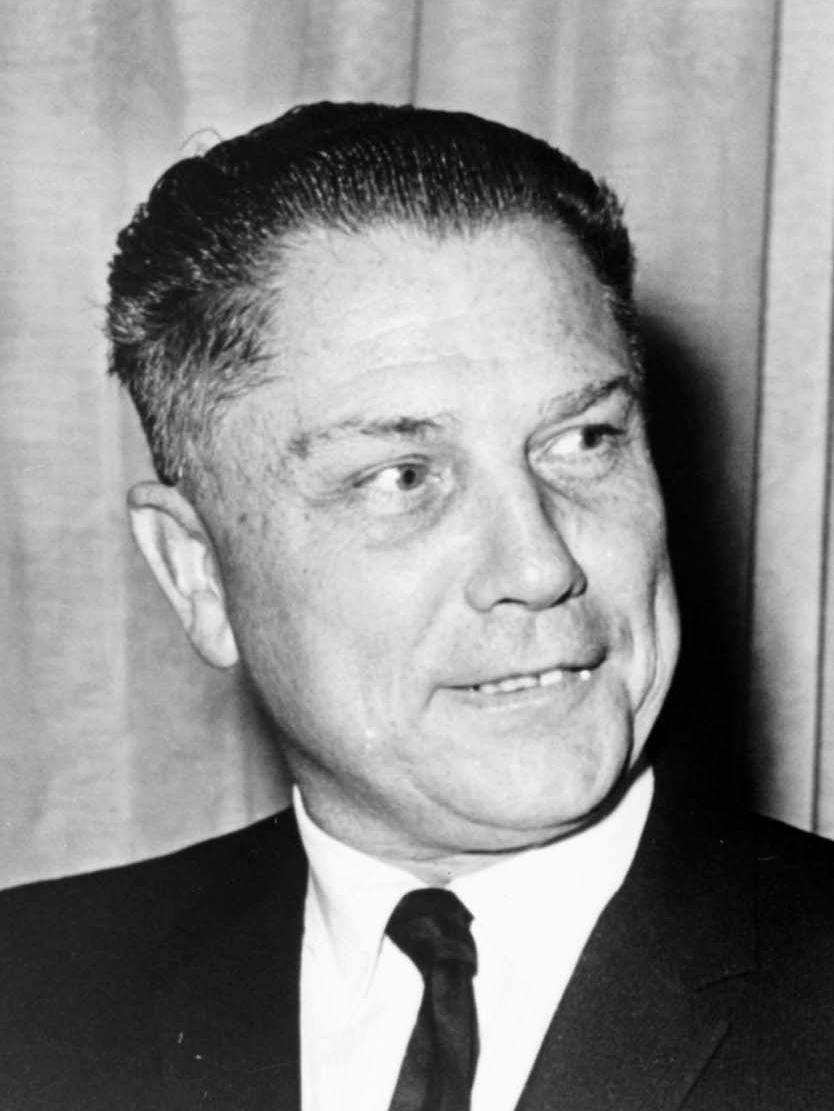
On July 30, 1975, Jimmy Hoffa disappeared without a trace. He was last seen at the Machus Red Fox restaurant in Bloomfield Township, Michigan, after 2 p.m. He was supposed to meet a couple of high-profile mobsters: Michigan’s own Anthony Giacalone, aka Tony Jack, and Genovese family capo Anthony Provenzano, aka Tony Pro. Provenzano and Hoffa used to be close when the latter headed the Teamsters. But they had a falling out at some point, and this sit-down was meant to bury the hatchet. However, at around 2:30 p.m., Hoffa used an outside payphone to call his wife and tell her that he had been stood up, but that he’d be home by 4 to cook dinner. About half an hour after that, he called a friend named Louis Linteau.
Several witnesses reported seeing Hoffa in the restaurant’s parking lot, pacing angrily in front of his Pontiac Grand Ville. Eventually, sometime after 3 p.m., Hoffa left the restaurant, but not in his own car, which was left unlocked in the parking lot. Instead, one eyewitness claimed that Hoffa got in the back of a large, dark sedan and drove off, accompanied by two or three other men. And that was the last time that anyone heard from Jimmy Hoffa. He was 62 years old at the time of his disappearance, and was declared dead in absentia seven years later, on July 30, 1982.
So now the only question left is: What happened to Jimmy Hoffa? Well, if we’re being realistic here, that question was answered decades ago – the mob had him whacked. The only things missing are the finer details: who ordered the hit, who pulled the trigger, and what happened to the body?
And that’s where things get tricky because, over the years, half the people in the country have claimed to know what really happened to Jimmy Hoffa. But they’re all variations on the same theme: the mob didn’t want Hoffa to become president of the Teamsters again. But despite their opposition and, in some cases, direct threats, he was determined to carry on. So one or more of them arranged for him to take a permanent dirt nap.
But who exactly was responsible is nigh impossible to determine with certainty, especially now 50 years later, when almost everyone involved is dead. Was it Giacalone or Provenzano? They seem like the obvious suspects, since they lured Hoffa to a meeting and didn’t show up. They were both investigated, but there was no solid evidence against them. Of course, they denied any involvement.
Was it Frank Sheeran, like in The Irishman, acting on the orders of Russell Bufalino? The FBI examined the house where Sheeran supposedly shot Hoffa, and although they found traces of blood, DNA tests showed it didn’t belong to the former union boss.
For what it’s worth, Hoffa’s son, James P. Hoffa, asserted that his father was assassinated as a result of a conspiracy between Frank Fitzsimmons and the Detroit mob headed by Tony Jack and his brother, Vito Giacalone, aka Billy Jack. And there’s at least one informant who claimed to have witnessed Billy Jack kill Jimmy Hoffa, although he refused to testify. And as recently as July of this year, another former mobster named Nove Tocco came forward claiming that the shooter was a Detroit gangster named Anthony Palazzolo, aka Tony Pal. In other words, the answers keep on coming, but we may never find out which one is the actual truth.


